
Woodstock GA Concrete Curing Times: What Georgia's Climate Means
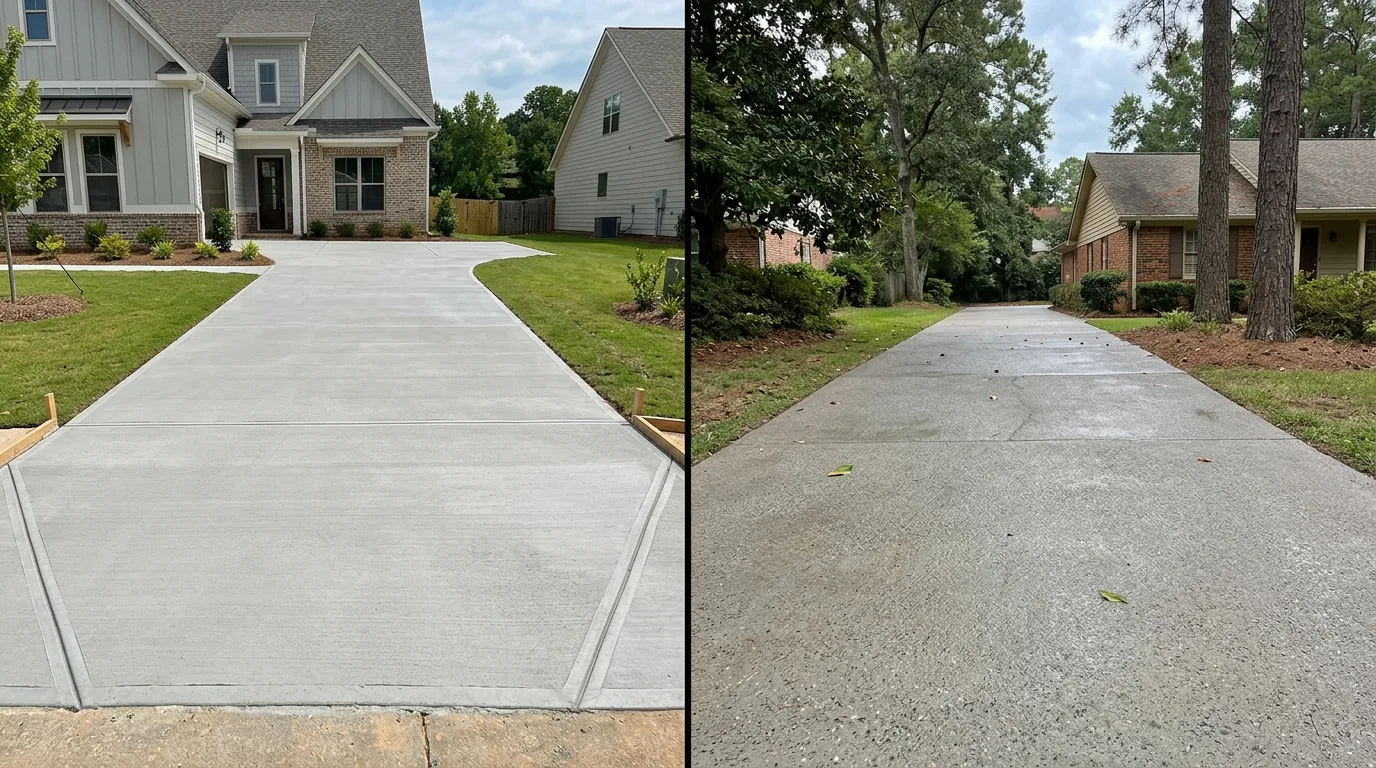
Concrete reaches approximately 70% of its design strength at 7 days and 99% at 28 days under standard conditions — but Georgia’s humidity, summer heat, and Cherokee County’s specific clay soil environment mean that “standard conditions” is rarely what you actually get. Understanding concrete curing in Woodstock’s climate helps homeowners know when it’s safe to walk on a new slab, when to park on a new driveway, and why the 28-day mark matters even if the surface looks and feels solid at day 10. In this post, we cover what the curing timeline looks like in practice for the main concrete applications in Cherokee County.
Questions About Your New Woodstock Concrete Pour?
We walk you through every step. Call Woodstock Concrete Pros at (888) 376-0955.
Why Curing Time Matters More in Georgia Than National Guides Suggest
Concrete curing is a chemical process, not a drying process — a critical distinction that affects how Georgia’s climate interacts with it. Hydration of cement creates the crystalline structure that gives concrete its strength. This process needs water and the right temperature range to proceed correctly. Too hot and it proceeds too fast, producing lower-ultimate-strength concrete with higher internal stress. Too cold and it stops almost entirely.
In Woodstock’s summer — June through August — ambient temperatures regularly exceed 87°F and surface temperatures on concrete in direct sun can reach 120–140°F. At these temperatures, evaporation from the fresh concrete surface occurs faster than the hydration process can consume the mix water, which can leave the interior insufficiently hydrated while the surface cures prematurely. The result is a slab with lower compressive strength than the specified design mix would produce under standard conditions.
Cherokee County’s humid subtropical climate also creates complications during the wet season. Excessive moisture curing — rain on fresh concrete before initial set — can dilute the surface paste and reduce surface hardness. Experienced contractors in Woodstock account for both extremes: monitoring for heat evaporation in summer and rain infiltration in spring.
Types / Options: Curing Methods Used in Woodstock
Curing compound spray: The most common method for residential flatwork in Cherokee County. A spray-applied membrane-forming compound is applied immediately after finishing to trap the mix water in the slab for the critical first 7 days. Fast, economical, and effective for most residential driveways and patios. The compound degrades naturally over 3–4 weeks.
Wet curing (burlap or poly): Burlap soaked in water and covered with plastic sheeting is kept wet over the slab surface for 7 days. More labor-intensive than spray-applied compound but produces the most uniform hydration conditions — the slab is kept at consistent moisture throughout the cure period. Used for higher-specification slabs, decorative flatwork, and situations where achieving maximum strength is critical.
Evaporation retardant: Applied to fresh concrete immediately after screeding in hot, low-humidity, or windy conditions — all of which occur in Cherokee County’s summer. Retardant slows evaporation from the surface, buying time for the concrete to develop sufficient early strength before the surface cures too quickly. Not a substitute for curing compound, but used in combination with it during challenging summer pours.
Insulating blankets (winter): Used in Cherokee County during winter pours when ambient temperatures approach or fall below 40°F. Insulating blankets trap the heat of hydration within the slab, maintaining the minimum temperature needed for hydration to continue. Essential for pours scheduled in Woodstock’s November–March window when overnight lows drop below 40°F.
Practical Uses: Concrete Curing Timeline for Common Woodstock Projects
- Concrete driveway: Initial set (can walk carefully without disturbing finish): 24–48 hours. Light foot traffic: 3–5 days. Initial vehicle traffic: 7 days minimum (most contractors recommend 10–14 days for safety). Full design strength: 28 days. Do not park heavy vehicles (loaded pickup trucks, vans) until 28 days have passed.
- Concrete patio: Initial set for foot traffic: 24–48 hours. Furniture placement: 7 days minimum. Heavy planters or built-in features: 28 days. Do not pressure wash until 30 days.
- Concrete slab (garage or shed pad): Do not drive on or load the slab floor with heavy equipment until 7 days; avoid concentrated point loads (jack stands, heavy shelving) until 28 days.
- Stamped concrete patio: Stamped surfaces require more care during cure because the decorative surface is more vulnerable to damage when the concrete is early-strength. Avoid walking on stamped surfaces for 24–48 hours after the pour. No furniture until 7 days. Sealer application at 28 days after curing.
- Concrete repair/resurfacing overlay: Repair mortars and overlay products cure faster than full concrete — most achieve foot-traffic strength in 24–48 hours and vehicle-traffic strength in 48–72 hours. Follow the specific product’s curing instructions.
How Georgia’s Summer Heat Affects Curing in Cherokee County
The practical consequence of Georgia’s heat for Woodstock concrete is accelerated initial set — the concrete stiffens faster, which compresses the finishing window for decorative work and increases the risk of surface cracking from moisture gradient differences between the surface and interior.
Contractors pour driveways in Cherokee County’s summer months as early as 6 AM to complete the pour before the hottest part of the afternoon. Evaporation retardant is applied immediately after screeding. Finishing is completed as quickly as possible. Curing compound is applied before the crew leaves the site. In July and August, this sequence is critical — a summer driveway pour without these adaptations can develop surface craze cracking that wouldn’t occur in October under the same mix design.
Your Woodstock Concrete Project Done Right in Any Season
We schedule and manage pours for Cherokee County's climate conditions. Call (888) 376-0955.
Cost Factors: How Curing Method Affects Project Cost
Standard curing compound application is included in most residential concrete estimates in Woodstock — it’s the minimum acceptable practice, not an upgrade. Wet curing with burlap and plastic adds labor cost: approximately $0.25–$0.50 per square foot for a residential slab. For a 600-square-foot driveway, that’s $150–$300 additional.
Evaporation retardant adds $100–$200 per pour for material and application time. Winter pour precautions — heated concrete mix water, temperature monitoring, insulating blankets — add $300–$600 for a standard residential project.
These costs are reasonable investments compared to the cost of a slab that cures with reduced strength or surface cracking due to inadequate curing measures. A driveway that needs resurfacing or section replacement 5 years after installation because of poor curing practice represents a loss that far exceeds the savings from cutting the curing step.
Frequently Asked Questions
How long does concrete take to cure in Woodstock GA?
Concrete reaches approximately 70% of design strength at 7 days and 99% at 28 days in standard conditions. Georgia’s summer heat can accelerate early strength gain but may slightly reduce ultimate strength if evaporation is not controlled. The practical timeline for Woodstock driveways: light foot traffic at 3–5 days, initial vehicle traffic at 7 days, full vehicle loading at 28 days.
When can I park on my new concrete driveway in Cherokee County?
Most contractors recommend waiting 7 days before any vehicle traffic on a new concrete driveway in Woodstock, and 28 days before regularly parking vehicles. The 7-day mark reflects early strength gain from cement hydration; the 28-day mark is when concrete reaches its full design compressive strength. Heavy vehicles — loaded trucks, vans, SUVs — should wait the full 28 days to avoid surface marking or cracking from concentrated loads on early-strength concrete.
Does Georgia’s heat make concrete cure faster?
Higher temperatures accelerate the rate of cement hydration, which means concrete gains strength faster in Georgia’s summer than in cooler climates. However, if the surface evaporation rate exceeds what the mix water can supply, the quality of the cured concrete is reduced — resulting in a faster-curing but weaker slab. Professional contractors compensate with evaporation retardant, early morning pours, and curing compound to balance the temperature-driven acceleration against moisture loss.
Woodstock Concrete Poured and Cured for Georgia's Climate
Proper curing on every project. Call Woodstock Concrete Pros at (888) 376-0955.
Related: