
Woodstock GA: Concrete vs Asphalt Driveway — Which Wins?
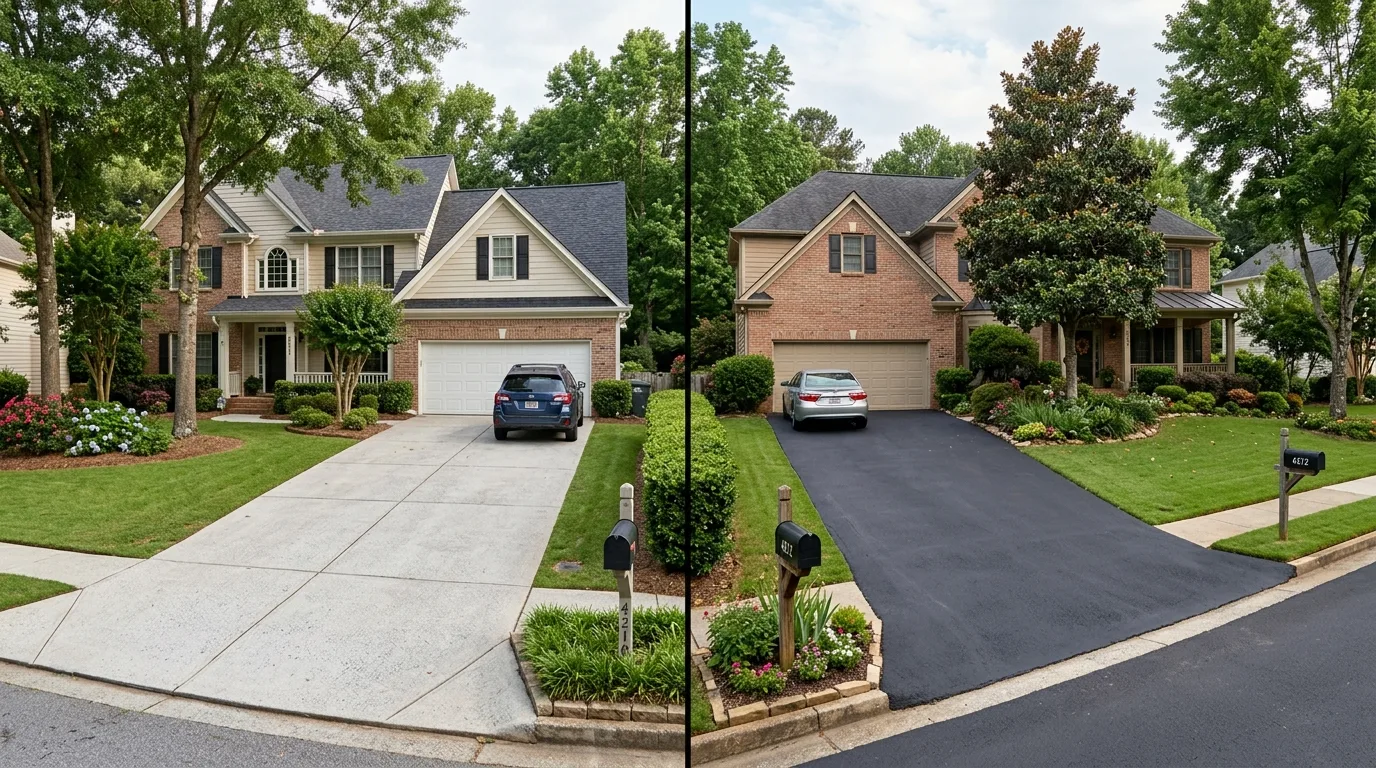
Is a concrete driveway worth the higher upfront cost compared to asphalt in Cherokee County? The honest answer depends on how long you plan to stay in the home, how much maintenance you want to do, and whether Georgia’s specific climate conditions change the usual math. The standard talking point — “concrete costs more upfront but lasts longer” — is accurate but incomplete for Woodstock homeowners. Cherokee County’s red clay sub-grade, humid summers, and occasional winter freeze-thaw cycles affect both materials differently, and the comparison looks different here than in other parts of the country. In this post, we cover what both materials actually deliver in Woodstock.
Get a Concrete Driveway Estimate for Your Woodstock Home
Free written estimates for concrete installation in Cherokee County. Call (888) 376-0955.
Why the Comparison Differs in Cherokee County
Both concrete and asphalt require a stable sub-base to perform well, but Cherokee County’s expansive Ultisol clay creates a more demanding sub-base environment than most national comparisons assume. Asphalt, being a flexible material, can accommodate some sub-grade movement by flexing rather than cracking — but extreme clay movement creates the same ruts and depressions in asphalt as it does cracking in concrete. The clay management challenge is the same for both materials; only the failure mode differs.
Georgia’s summer heat is the second distinguishing factor. Asphalt softens in high heat — in Woodstock’s July and August when surface temperatures on exposed pavement regularly reach 140–160°F, asphalt can become plastic enough to rut under turning vehicle loads and leave marks under kickstands. Concrete does not have this behavior. For homeowners in exposed, south-facing driveways in Cherokee County, this is a meaningful difference in daily experience.
Types / Options: Concrete Driveway vs Asphalt Driveway in Woodstock
Concrete driveway: Hard, rigid surface. Initial cost $5–$8 per square foot in Woodstock (plain broom finish). Lifespan 30–50 years with proper installation and routine sealing. Maintenance: seal every 3–5 years, fill cracks promptly. Resistant to gasoline and oil surface damage. Reflects heat rather than absorbing it — cooler surface in Georgia’s summer. Does not rut in heat. Repairs are more visible when a section must be replaced.
Asphalt driveway: Flexible petroleum-based surface. Initial cost $3–$5 per square foot in Woodstock. Lifespan 15–25 years with regular sealcoating. Maintenance: sealcoat every 2–3 years (required for longevity, not optional in Georgia’s climate), fill cracks annually, possible resurfacing overlay at 10–15 years. Black surface absorbs significant heat in Georgia’s summer. Softens in extreme heat under turning or stationary loads. Repairs blend more visibly because the black color is uniform.
Concrete with decorative finish: Stamped, exposed aggregate, or colored concrete starts at $8–$12 per square foot and can reach $21+ for elaborate patterns. Adds curb appeal that asphalt cannot match. Lifespan same as standard concrete with appropriate maintenance for the finish type.
Practical Uses: Where Each Material Makes More Sense in Woodstock
- Concrete is clearly better for south-facing, full-sun driveways in Woodstock where summer surface temperatures matter. Concrete stays cooler and doesn’t develop the heat ruts that asphalt can show in Cherokee County’s July–August peak heat.
- Concrete is better for long driveways (over 100 feet) where the 30–50 year lifespan translates to meaningful savings in replacement cycles over the life of the property.
- Concrete is better if curb appeal matters for resale — decorative concrete options significantly outperform asphalt for visual impact in the Woodstock market, particularly in communities like Bradshaw Farm and Eagle Watch where home values support the investment.
- Asphalt is cost-competitive for shorter driveways (under 600 sq ft) where the upfront savings are significant and the homeowner plans to sell within 10–15 years. At a 10-year horizon, the lower upfront cost of asphalt can offset the shorter replacement cycle.
- Asphalt is easier if budget is the primary constraint and you’re replacing a failed driveway in winter — asphalt can be installed in cooler weather that concrete pours require more management to handle.
- Neither material eliminates the need for sub-base preparation on Cherokee County’s clay. Both require a compacted gravel base to manage clay movement. Skip the base preparation on either material and you’ll be replacing it within 10 years.
How Georgia’s Climate Affects the Lifetime Cost Calculation
The 30-year lifecycle cost comparison for a 600-square-foot driveway in Woodstock:
Concrete: Initial install $3,000–$5,000. Resealing every 4 years × 7 events = $1,050–$2,800. Zero resurfacing needed if maintained. Total 30-year cost: $4,050–$7,800. No replacement in this window.
Asphalt: Initial install $1,800–$3,000. Sealcoating every 2.5 years × 12 events = $1,200–$2,400. Resurfacing overlay at year 12–15: $1,800–$3,000. Replacement at year 20–25: $1,800–$3,000. Total 30-year cost: $6,600–$11,400. One replacement in this window.
Georgia’s summer heat accelerates asphalt aging, pushing the maintenance and replacement timeline shorter than national averages suggest. Concrete’s higher upfront cost is generally recovered over a 15–20 year period for Woodstock driveways.
Concrete Driveway Installation in Woodstock — Built to Last 40 Years
Free estimates with full scope details. Call Woodstock Concrete Pros at (888) 376-0955.
Cost Factors: What the Numbers Look Like in Cherokee County
For a standard 600 sq ft driveway in Woodstock (2026 pricing):
- Plain broom-finish concrete: $3,000–$5,000 installed
- Asphalt (2 layers): $1,800–$3,000 installed
- Upfront difference: $1,200–$2,000
The upfront savings for asphalt disappear in year 10–15 when sealcoating costs, potential resurfacing, and the shorter replacement cycle are factored in. For homeowners planning to stay more than 10 years, concrete is the more economical choice. For homeowners planning to sell within 5 years, the upfront savings from asphalt may not be recouped in resale value, but the lower investment reduces exposure.
Frequently Asked Questions
Is concrete or asphalt better for Woodstock GA driveways?
Concrete is generally the better choice for Woodstock homeowners planning to stay in the home for 15+ years. The longer lifespan (30–50 years vs 15–25 for asphalt), resistance to Georgia’s summer heat, and lower total lifecycle maintenance cost make concrete the more economical choice over time. Asphalt’s lower upfront cost makes it competitive for shorter-term ownership or budget-constrained situations.
Does asphalt last as long as concrete in Georgia’s heat?
No — Georgia’s summer temperatures are one of asphalt’s primary limitations. Surface temperatures on exposed black asphalt in Woodstock regularly exceed 140°F in July and August, causing the material to soften and potentially rut under heavy or turning vehicle loads. Concrete is unaffected by these temperatures. Asphalt in Georgia typically needs resurfacing at 12–15 years and full replacement at 20–25 years; concrete properly installed lasts 30–50 years.
What is the best driveway material for Cherokee County’s red clay soil?
Both concrete and asphalt require a compacted gravel sub-base to perform well on Cherokee County’s expansive clay — neither material eliminates the soil challenge. Given equal sub-base preparation, concrete’s rigidity means it either performs well or fails in clearly visible cracks; asphalt’s flexibility means it can accommodate more sub-grade movement but may develop ruts or depressions rather than cracks. For driveways in communities with higher home values where aesthetics matter, concrete’s performance and visual range clearly outperform asphalt.
Cherokee County Concrete Driveways Built for Georgia's Climate
Free estimate for concrete driveway installation in Woodstock. Call (888) 376-0955.
Related: